- No products in the cart.

Brussels

Brussels. It's not a name that conjures up an excited yearning in the heart of typical travellers. To some people three things spring immediately to mind, when the squidgy-soft syllables of 'Bruss-els' are spoken – bureaucracy, boredom and sprouts.
This is a great shame, because beneath the veneer of a city sometimes seen as just a stuffy administrative centre, Brussels is in fact an historical, fun and happening city – more than worthwhile the visiting.
It is, after all, the city whose mascot is a little boy peeing onto the heads of soldiers of a rival army. It's the capital of the country where the comic book was invented and home to the iconic comic strip hero Tin Tin (and in fact has a renowned comic museum to brighten up its houses of culture).
And it's also the city that has bought us the diverse pleasures and sublime sourness of Belgium's lambic beers.
So put any preconceptions to one-side. For all its multi-national mix-up and pompous post-war architecture, in its heart Brussels has kept true to the spirit of the cultural fusion that is Belgium. So if you're coming to Belgium for something a bit deeper than a post-stag hangover, you'd do well to consider making the capital city more than just a point of entry for your Belgian stay-over. Better by far to make your stay fit around Brussels.
This city isn't just the capital of Belgium (and unofficially also of the EU), its largest city (at over 1 million citizens), and the home of a quiver of international organizations (NATO, the European Commission, the European Parliament and, of course, the European Brewery Convention).
Brussels is also the most diverse of Belgium's big cities, by far. Although three-quarters of its population are classed as Belgian nationals, most were not born here. A third of Brusseleers call themselves Brusselaar (Dutch-speaking Belgian) or Bruxellois (French=speaking Belgian), but a third originally came from France and other European countries. And another third were born as far afield as Congo or Rwanda, Morocco or Turkey.
The city lies about 115 km inland from the coastal town of Ostend, sitting just north of the line that divides the Dutch-speaking Flemish community of from the French-speaking community.
It started as a tiny hamlet on an island in the River Senne, and literally dug its way out of the marshes surrounding the area, as it laid out drainage ditches and canals.
In fact the name Brussels probably comes from the Dutch 'Broeksel', meaning 'home in the marsh'. Its damp beginnings are recognised today in the bright yellow iris flowers that are used on the city's coat-of-arms – and as the name for one of the beers of the city's Cantillon brewery – Iris.
History

But let's put that fine beer down for a moment, and rewind back to the start of Brussels' journey proper – to 979, when Duke Charles of Lower Lorraine bought a bag of holy bones from a village to the west, Moorsel, and deposited them at Brussels' (then) tiny chapel.
Adding a little saintly aura to your local chapel (via the holy relics of Saint Gudula in this case) was, of course, a time-tested way of boosting an no-place hamlet up into the league of up-and-coming towns.
Saint Gudula's bones meant more pilgrims, which meant more customers for the market, which meant growing trade – and more taxes for the Count. Brussels, lying at the crossroads of traffic between Bruges and Ghent, France and Cologne, was able to leverage up on that initial religious 'leg-up' from Saint Gudula.
The market square of 'Nedermerct', pre-cursor of today's Grand-Place, was already marked out by the 11th century. By the 12th, Brussels had grown to a city of 30,000 people. At this point the ruling Counts of Leuven became the Dukes of Brabant, and the city built its first defensive walls. By the end of the 14th Century it had spilled outside those, and another set of walls were built – traces of these walls can be seen in Brussels road layout, even today.
Brussels became known as the Princely Capital, focussing on the production of fine goods, quality silks and gold-spun tapestries for the rich of Paris and Venice.
At this time it was also home to one of the three great Flemish painters (or the 'Vlaamse Primitieven'), Rogier van der Weyden, who was more popular than the famous van Eyck brothers, in his time.
When the Burgundian Netherlands, with Brussels as its dukely court, passed onto the Hapsburg Charles V (yes, him again) in 1506, the history of the city became snarled up with that of the Holy Roman Empire, Spain and the emerging Dutch nation. It was in Brussels' Cathedral of Saint Gudula that Charles V became King of Spain in 1515.
And it was in Brussels Coudenberg Palace that Charles V gave up his crown in 1555. The city was embroiled in the war between catholic Spain and the rebellious protestant Dutch provinces (the Eighty Years War), and for a while was ruled by the Calvinist rebels. It never lost its adherence to Catholicism, however.
The war left Brussels relatively unscathed, but 50 years later, in 1695, an army from France's Sun King (Louis XIV) came a-calling – with a whole division of cannons and mortars, and thousands of shells, in tow.
Louis XIV wanted a city in the Spanish Netherlands destroyed, as a diversion to his war with the Grand Alliance – and defenceless Brussels was chosen as the target. A two-day artillery onslaught started a massive fire in the centre of Brussels – which left up to five thousand houses burned to the ground – and 11 churches, several convents, and most of the buildings around the Grand-Place were flattened.
A hundred years later Napoleon was said to have remarked that the Brussels Bombardment was "as barbarous as it was useless."
The next century or two would see Brussels flip-flop between Austria, France and Holland, as Flanders remained a pawn in the game of international politics being played at the time.
By the 19th century, the locals had had enough. It was time for Belgium to be for the Belgians. And in 1830 Brussels was (literally) centre-stage in the Belgian revolution – kicking off the fight for independence from the Kingdom of Holland with... an opera.
Getting There & Getting About
_571x768.jpg?1393613354)
As the capital of Belgium, Brussels is pretty easy to reach from whatever direction, whether you're coming by plane, train, or auto-mobile. The city is well served by its main international airport (Brussels Airport), which is about 11 km north-east of the centre of town.
It has dozens of international and domestic airlines connecting it to destinations across Europe, the UK and the world, there are also direct flights from and to the United States.
There is also the smaller Charleroi Airport, 45 kilometres south, with mainly low-cost airlines on its roster flying to destinations accross Europe and the U.K.
Brussels has three big rail-stations, with most international visitors coming in through Brussels South, which hooks into the high-speed Eurostar network: London St. Pancras to Brussels is less than 2 hours on the Eurostar.
If you'd rather dodge the 'Chunnel', and bring your car over by ferry, the road from the Channel ports to the capital is a simple drive down the main E40 motorway. Simple enough to reach, but not always so simple to get around; this is a very busy city, with up to 2 million people commuting in each day, many by car.
Travel around the centre is, however, well-covered by a comprehensive tram and bus network operated by MIVB/STIB. The integrated tickets can be used on the good rail connections into/out to the surrounding suburbs.
Shared bicycles are also a feature of the city centre. But whether you're walking, cycling, driving or tram-riding, be prepared for plenty of company. And remember, when you get fed op with the city almost nothing in Belgium is much further than two hours away from Brussels.
Accommodation

As a city at the centre of both European and international politics and business, Brussels is packed to the gills with hotels of all classes (with over 30,000 beds in total). There is, however, a firm emphasis on the top-end of the market, catering to needs of the well-heeled coming here for business, rather than pleasure.
Because of the high demand, staying close to the city centre won't be super cheap. So if cost is an issue, you may want to look further out, and travel in by tram or bus.
In addition to traditional hotels, there are many 'apart-hotels', which are well-located, well-furnished apartments rented out on a (very) short-term basis to visitors.
While geared to the travelling EU bureaucrat or businessman, they can be useful for those looking for their Brussels stay stretching out longer than a week or two. There are also some reasonably priced hotels close to Brussels Airport, and a number of budget hotels scattered around the suburbs.
For those that don't mind sharing, there are a few hostels in the centre of town. There are also a number of larger hostels further out. See our Brussels travel guide categories Hotels and B&B's for full details on accommodation.
For the Love of Beer

As the last resting place of beer saint Gambrinus and the home of the legendary lambiek beers, Brussels is one city that should have much to offer to beer connoisseurs. And that it does; but like many things in this perplexing city of contrasts, you may need to work a little harder to find the best.
Of course there are the standard staples of Belgian beer-craft by the glassful, at the numerous cafés and tourist-slanted bars, strategically located next to the main sights in town. But to get close to the beating Brussels heart of the of Belgian beer you may need the guiding hand of a local.
Or pop into the most interesting working breweries in town, the century-old Brasserie Cantillon, lying close to the Station Gare du Midi/ Zuidstation in the south-west of the city. The brewery also houses the Gueuze Museum.
This is a family-owned brewery that has lambiek in its blood, home to a full complement of – oude gueuze's, faro's and kriek's. It also takes a very creative and imaginative approach to its beer-craft.
It uses only organic wheat for its lambiek source beers. On a visit here (and when in luck) you'll also get to see the brewing of lambiek up-close, including the old coppers, and the open-aired attic where the wort is left open to the breeze. It is the unique bacteria of the Senne river valley that apparently filters in to work their 'lambiek magic' on the wort.
One of the best ways to appreciate Brussels' oude gueuze is in one the increasing numbers of cafés and bars that specialize in serving the most refined of Belgian beers.
A more recent addition to the brewing scene in Brussels are the Zennebrouwers (Brasserie de la Senne), who had been brewing for more than a decade before they were finally able to set up their own brewery on Brussels' soil in 2010. Ever since they began to brew, Yvan De Baets and Bernard Leboucq have been producing beers packed with taste. The brewery itself can't be visited but you can pass by for a beer tasting session. If your short on time, you could do worse than catching up on the beery side to Brussels at the Museum of Belgian Brewers, conveniently located in the famous Brewers House on the magnificent Grand-Place.
As well as exhibiting the history of Belgian beer, and the ever-changing tools of the trade, a visit to the Museum ends with a tasting.
2018 will also see the opening of the Belgian Beer Temple, a visitor experience that will highlight all aspects of Belgian Beer Culture. An equally good beer-education, though, is had in the streets around that other top tourist-attraction, the Manneken Pis. Here, you can be schooled in some fine Brussels bar culture, but without all that dust and labels.
There are also two main beer events taking place each year, the impressive Brussels Beer Weekend is organised by the Federation of Belgian brewers, taking place every year in the first half of September and the Brussels Beer Challenge, an international "Beer Concours". Be sure to visit our Beer Tourism Destinations in and around the Belgian capital.
Food & Gastronomy
_1024x683.jpg?1393613361)
Brussels is a notoriously fabulous city for fine cuisine. After all, it has to cater to the refined tastes of Europe's top bureaucrats and its itinerant political class, who decamp to the city at every opportunity. This city has more Michelin starred restaurants than Amsterdam or Berlin.
But there's more to Brussels than swanky restaurants pandering to a wealthy clientèle. The Brusseleers have taken the best of Flemish cuisine, and successfully dressed it up with a dash of French flare (not to mention partnering it to some wonderfully diverse beers).
And there are plenty of eateries, among Brussels' restaurants, able to acquaint you with these gastronomic delights, without relieving your wallet entirely of its contents.
There are obvious emblematic foods to try, one that Brussels likes to claim as its own – their gaufres or wafels, authentic Brussels waffles, best served with a generous drizzling of chocolate; the renowned chocolate pralines; or moules frites, that signature combo dish of mussels and fries. Brussels likes to put its own twist on these – for example, having your moules served à la bière: Zeeland mussels cook especially well with the local yeasty witbier/bière blanche. Good town-restaurants will also have Brussels versions of dishes like 'anguilles au vert' (wild-caught eel in a fresh-green herb sauce) or stoemp (a rich Brussels variation to puréed potatoes, vegetables and bacon).
One to look out for is 'Américain frites'. This is not, as its name might suggest, a US fast-food version to the traditional Belgian frites.
It is a rough mix of raw minced beef and seasoning, bound together with eggs, and served with crisp Belgian frites.
A great accompaniment to a beer-based lunch, in the genuine Brussels brown cafés, has to be the plattekaas. This flat white cheese is a quark – made without rennet – and is usually paired to slice of rye-bread, radishes and a Brussels lambiek: making for a perfect Belgian 'ploughmans'! Next to the local cuisine the city is full of restaurants serving great food coming from literally every corner of the known world. This city's restaurant scene is as international as its inhabitants.
Visit our Sweet Tooth and Where to Eat travel guide categories for more information.
Shopping & Markets
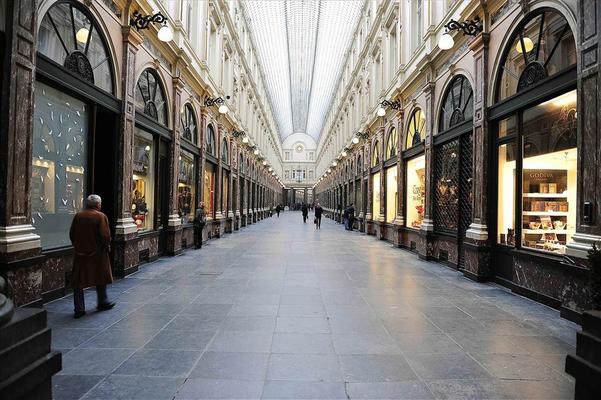
Shopping has a good pedigree in Brussels. The market square of the Grand-Place has been at the heart of Brussels for more than a thousand years. The wealth that the city's merchants made from trading is very much in evidence here, in the architectural trappings all around this UNESCO-recognised site.
But while the Grand-Place remains the gravitational centre of the city for tourists, shoppers will find their sport scattered more widely through Brussels these days.
Luxury shopping has inevitably come to define parts of the capital, with the district of the Sablon perhaps showing off its crème de la crème – particularly in the line of antiques and paintings. The Rue Antoine Dansaert is lined with of high-status fashion boutiques, and designer stores, great if cutting-edge couture is your thing.
Another big-spend hotspot is the Galeries St Hubert, one of the world's first shopping arcades, which opened in 1847.
This is entered from the Rue de la Colline, and is wonderfully decorated, with chandeliers dripping from its glass skylight roof. All definitely worth taking a look at, even if you haven't got two Euros to rub together. But if you like to take your shopping more 'mainstream' (read affordable), try the pedestrianised area around Rue Neuve/Nieuwstraat. Here you will find the more typical malls, modern generic chain stores and plenty of bustling crowds.
Of course markets remain an integral part of Brussels, and at Brussel-Zuid/Gare du Midi you'll find a nice antidote to the slightly anonymous City2 shopping centre.
The Market held here on Sunday mornings is a massive collection of stalls, laden with fresh produce (local and international) such as vegetables, fruits, cheese, meat and fish – a great sensual treat. The markets of the Marolles have historically served Brussels' lower classes, and that tradition continues today, despite the area's more recent elevation up the social scale.
Bargains and oddities can be had from the stalls at the flea market at the Place du Jeu de Balle, which opens there every morning. Be sure to check our Shopping listings for more information on shopping and markets in Brussels.
Sightseeing & Culture

Top sight in Brussels? Forget the many superb museums, the great art galleries, the glories of the Grand-Place, or the beauty of St. Michael and St. Gudula Cathedral. What tops the list of Brussels attractions is a statue of a little boy, piddling in a fountain.
The Manneken Pis is Brussels' 400-year old joke that just never gets old. And the Brusseleers don't seem to tire of dressing this bronze sculpture up in all manner of guises, a never-ending opportunity to literally 'take the pee'. But the question has to be asked – why?
There are many legends justifying why the city felt the need to commission Hiëronymus Duquesnoy the Elder to cast this bronze, and place it at the corner of Rue de l'Étuve/Stoofstraat and Rue du Chêne/Eikstraat. The oldest (and best) is that the title of Duke of Leuven passed, in 1142, to a certain infant, Godfrey III.
His prescence on the battlefield was hoped to be inspirational, even though he was only two. And so it proved. Godfrey III, was hung in a basket, in a tree above the battlefield. From this vantage the little lord decided to add his contribution, by peeing onto the heads of the enemy troops – by doing this they lost heart, and the battle. Once you've satisfied your urge to see the Manneken Pis, it's only natural to look for some equally elevating examples of Brussels culture.
A short walk back up the Rue de l'Étuve/Stoofstraat won't disappoint. The street opens up onto the dramatic visage of the Grand-Place, recognised as a World Heritage Site by UNESCO in 1988.
Dominating this ancient square of commerce and public spectacle is the Brussels Town Hall – one the oldest and grandest town-halls in Europe.
The first wing was started in 1402, with the second wing and the 96-metres high tower completed in 1455. The early importance of the merchants to this city can be seen by the fact that this is one of the few cities in the world where the town-hall is taller than the cathedral. Opposite the Brussels Town Hall is 'the house the duke built'. Now called the Maison du Roi (King's House), or Broodhuis (Bread-house), this was the Duke of Brabant's reposte to the Brussels merchant's growing power.
The Grand-Place is also home to the gilded 15th-century fronts of the GuildHalls.
What's remarkable is that the whole architectural treasure-trove of the Grand-Place was raised to the ground in the French Bombardment of 1695 – what we see now was painstakingly reconstructed by the people of Brussels over the subsequent 4 years. There's more impressive construction to gawp, at the Royal Palace of Laeken on the north-east edge of the city, but of this is of the transparent variety. The magnificently domed Royal Greenhouses of Laeken, built in 1874, are accessible for only 2 weeks in April and May, when the flowers are in full bloom. But timing your visit to coincide with this is well worth the effort.
While wandering around Brussels it is easy to be awestruck by so much classic architectural beauty; however, you should not forget that Brussels is also the city where most of Belgian Art Nouveau architect Victor Horta's work can be admired.
Victor Horta (1861-1947) is considered nothing less than a genius and played a prominent role in the creation and development of the Art Nouveau movement. Several of his town houses in Brussels have also been recognised as UNESCO World Heritage sites. Of course no tour of Brussels architectural points of interest would be complete without a visit to the Atomium, a giant 102-metres high chemistry lesson rolled into a sculpture. Built for Brussels' 1958 hosting of the World Fair, it consists of nine steel balls – representing the atoms of the iron from which it is made – which by the way, you can climb inside!.
Fun maybe, but a competitor in those Brussels fun-stakes is the Belgian Museum of Comics. This Museum explores the whole history of Flemish and French-language comics in Belgium – the nation, after all, which gave us Hergé and his 'Adventures of Tintin'. Peyo who created the 'The Smurfs', and many more...
The style that Hergé developed (the ligne clair or clear line) influenced a generation of comic artists. There's plenty of Tintin to see here, including sets and models, as well as other Belgian comic-book heroes, such as Spike and Suzy, Lucky Luke, Cubitus and Marsupilami.
Keep an eye out, when traveling around the city, and you're likely to catch one of these characters painted out large, on one of the many wall-murals dedicated to them. But Brussels isn't all about comics and amusing figures, art and creativity are serious business in the Belgian capital and should be admired.
The city has also given us some more contemporary famous names including Pierre Alechinsky (painter), Jacques Brel (singer), Audrey Hepburn (actress) and Brian Molko (singer of rock band Placebo).
Together with Jean-Claude Van Damme (actor) and Toots Thielemans (legendary jazz musician) they all have Brussels in common as their place of birth. Others like Karl Marx, Victor Hugo, Pieter Bruegel de Oude, Alexandre Dumas and Auguste Rodin stayed here for a while; and other iconic artists chose to settle and live their life in this dynamic, ever changing city.
One of their most famous representatives is the Belgian surrealist painter Réne Magritte (1898-1967). His life and work is still celebrated at the Réne Magritte museum. Find out more via Visit Brussels or see our Sightseeing and Culture travel guide categories.
Activities & Entertainment

Brussels does very well for itself when it comes to high culture. As well as the renowned opera-house of the Théâtre Royal de la Monnaie, there are several other major theatres in town, hosting a variety of productions – contemporary dance (another famed Belgian export product!), opera, ballet, plays and classical concerts.
There are plenty of small - to very large - concert venues in Brussels, which host shows with the world's biggest names in entertainment, as well as local and new talent.
If you're into folklore, Brussels can offer you the puppet experience at Theatre Toone, which has been running poechenelles shows since 1830.
You can find cinemas scattered across the city showing anything from independent world cinema to the latest blockbuster movies. A major plus for visitors is that Belgium is one of few European countries that doesn't automatically dub their films.
Most movies are shown in the original language version but with French and Dutch subtitles. When seeking quick fortune there's the Brussels Grand Casino to try your luck. Brussels caters to its visitors entertainment needs in the same way any other capital city does.
However, Brussels does have one huge advantage that not that many capitals can claim. The Sonian Forest is, by Belgian standards, a vast forest only minutes away from the city centre and is a green oasis, offering an escape from daily city life.
The beautiful woodland forms the perfect natural backdrop for some scenic relaxation, cycling or walking, it covers almost 5,000 hectares or 12,350 acres and is thought to be a remnant of a ancient forest that stretched from the banks of the river Rhine to the shores of the North Sea.
More or less 80% of the forest consists out of beech trees, many of which are over two centuries old. Find out more about activities in and around Brussels via the Things to Do and Sports travel guide categories.
B2B & Conferencing

When you step back, and remember that Brussels is the de facto capital of 500 million Europeans, it makes it a little clearer why this city has been called THE place to organize and host conferences, exhibitions, meetings and conventions of all shapes and sizes. Tally the numbers up, and Brussels has more than 60,000 meetings held within its precincts each year.
People come in part because it is so close to centres of power for a whole continent, in part because its centrally located both in Europe, and between the Americas and Asia, and in part because it has reception facilities rarely equalled elsewhere.
It built up an enviable infrastructure of facilities for looking after all those visitors. One of the most visible is the Brussels Exhibition Centre, lying on the northern limits of the city. With over 115,000 m2 of floor-space, across 12 exhibition halls, BEC is the biggest conference hall in Belgium.
The centre is able to deliver for conference organizers up to the grandest of scales. It has also built up an extensive organisational experience. Further into town there are many more conference centres large and small – the Centenary Palace in the Heysel Exhibition Park (home to the Atomium), the centrally located Square-Brussels Meeting Centre, or the The International Auditorium are just a few of the many impressive purpose-built facilities Brussels has to offer.
Add to that a fair number of hotels boasting four or more stars, and the meeting organizer is spoilt for the choice.
It makes sense, though, to get in touch with the relevant Brussels MICE (Meetings, Incentives, Conventions, Events) offices, so they leverage their local experience in your favour. The guidance you will receive from them will not only save you valuable time but also offers you access to some key contacts.
Brussels is in exceptional demand as a location for venues, so you'll need all the help you can get on the logistics, availability of venues, negotiating of discounts and special offers (from hotels and restaurants), and the booking of convention/exhibition centres.
Festivals & Events

As with the rest of the country Brussels has a well filled event and festival calendar, from world music festivals like Couleur Locale to the Brussels Jazz Marathon. But there's much more to discover festival and event-wise. Foodies will love "Culinaria" or the "Salon du Chocolat", there are film and theatre festivals and several international sporting events (Memorial Ivo Van Damme).. And it doesn't stop here!
The city also has its share of more folklore festivals, one of the more unusual being that of the Meyboom – an echo of a war between Brussels and Leuven.
It involves the selection, cutting down and parading of a tree – the Meyboom – which is displayed on the Grand-Place the day before St. Laurent’s Day (9 August). The parade is accompanied by poepedroegers who dress as giants, gardevils, who guard the tree, and the buumdroegers, who actually carry it. The reason for all the protection?
The right to hold the parade will be lost to the town of Leuven, if the tree isn't erected by 5pm. And who knows where the men of Leuven are lurking...Watch out for articles on events and festivals on the Beer Tourism and Brussels City Blog or check our relevant listings.
Nightlife

Without doubt Brussels has the most diverse nightlife scene in the country. It may sound a bit of a cliché but this city is young at heart and never sleeps. Nighttime entertainment can be literally found everywhere, even some brown cafés will stay open till the (very) early hours.
The modern music scene is thriving here too, fed in part by the diverse cultural backgrounds of the Brusseleers. For example, to the south of the main city centre, in the Matonge district, there are numerous African nightspots.
There is also a vibrant club scene in various parts of the centre, such as Place de St-Géry, and in the Marolles district. You will in fact find clubs in all sizes all around the city, from trendy and laid back cocktail lounges to happening clubs hosting international dj's and gay orientated clubs.
And all throughout the city, your night-life shenanigans are likely to be fueled by a plethora of late-opening bars. Visit our Nightlife page for more information.